
Marc Benioff from Salesforce is a master salesman, and I was certainly thinking WTF when he showed up with Dario from Anthropic announcing Claudeforce, yes Claudeforce, which is really exposing all of Salesforce’s workflows through MCP.


If you read the fine print, you can see where the value lies for SaaS system of record companies - it’s hard to have all of these rules replicated on the fly stochastically versus having them already deterministically set.
As Marc says:
Ironclad Governance — Zero Data Retention, full trust boundary, Salesforce-certified by default Probabilistic models alone can’t run a company. Deterministic systems alone can’t reason. Claudeforce fuses Claude’s reasoning with Salesforce’s trusted data and controls. The AI is the interface. This is how every business will run.
The skeptic in me is saying why wouldn’t Dario from Anthropic show up with one of its biggest customers by far. In addition, is this just Marc calling out his own eventual death meaning Claudeforce is just a stopgap before Anthropic eventually eats Salesforce’s lunch? Sure, it’s a real risk, but there’s nothing like competition from other frontier labs and Chinese open weight models to keep a company focused and building the deterministic layers underneath is just not something an AI company should be spending time on.
And with that Marc declared the SaaSpocalypse over with numbers to boot. Is this the roadmap for every SaaS company to go headless and let agents do the work and consume and pay?
Let’s take a look.
Back in April, Marc Benioff made a bold move: Salesforce began shifting beyond seat-based pricing, going headless and opening its platform so agents could access Salesforce data. I wrote about the shift in April 2026 in What’s 🔥 #494.
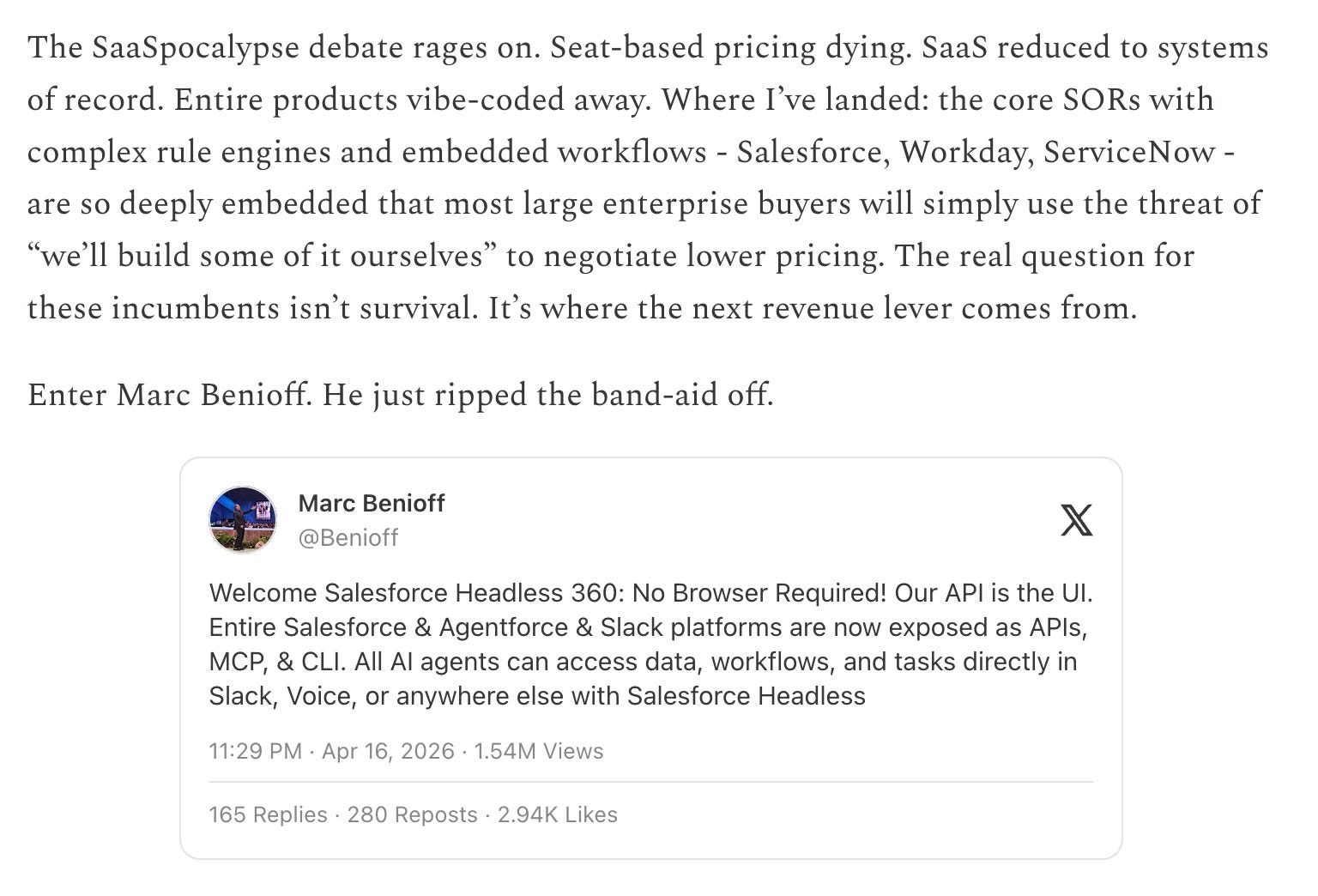
I further explained:
Short-term revenue hit. Long-term growth story. Do the math. 100,000 human users at $300/seat is $30M. Replace those seats with 1,000,000 agents making API calls 24/7 and the ceiling shifts from headcount to volume. Humans work 8 hours a day, 5 days a week. Agents work all the time. Consumption-based pricing in an agent-led world could dwarf what per-seat ever delivered. If you get the model right.
In other words, there could be short term pain but long term gain if the agent revenue eventually exceeds the seat-based revenue. What I didn’t account for is seat based revenue also expanded at companies like Salesforce!
Here’s an early look 2 quarters later: Salesforce is up big 📈.


Thariq from Claude Code summed up where we may be heading quite well - build and charge for agents!

Digging deeper, here are a few quotes from the Salesforce earnings call from Marc B.
Seats are not declining.
“Skeptics really said that seats would decline, and also that Agentforce sales and service and Slack all seats grew year-over-year. Skeptics said customers would leave, but attrition was near its lowest level ever. Skeptics said pricing power would erode, and A1E and A4X bookings more than doubled quarter-over-quarter.”
The top AI companies are not only using Salesforce but expanded 435% collectively YoY 🤯.
“Nine out of the top 10 AI companies in the world use Salesforce and Slack... These companies, these nine out of 10 top 10 AI companies, they’ve increased their spend with us by 435% year over year.”
Replit tripled its Agentforce sales seats. Anthropic runs its go to market on Salesforce. The labs are net adders of seats.
Agent traffic and MCP calls are 📈.
“We are told agents accessing our system would kill apps. Well, actually, usage is exploding. Agentic use of our apps through Model Context Protocol calls and CLI calls also surged sixfold, 6x.”
Salesforce CFO Robin Washington said that there were 3.2 billion agentic work units in the quarter, up 97% QoQ. As mentioned above, each agent call is a billable one against the system of record. While consumption revenue is still small compared to seats, it’s growing super fast.
Finally, let’s not forget that the architecture matters.
“Models are probabilistic systems. They are non-deterministic systems. But our system, those four layers that we talked about with data and apps and semantics and agents, those are deterministic systems.”
Permissions, sharing models, audit trails and business rules are what turn a database into a system of record. An LLM generating a UI on the fly produces none of them which means the layer about the SOR with governance, rules, context is super valuable.
I also highlighted why I thought systems of record had real staying power back in April.
There’s a deeper technical story here that matters for every enterprise deploying agents. As Salesforce EVP Jayesh Govindarjan told VentureBeat, early Agentforce customers hit a wall: “They were afraid to make changes to these agents, because the whole system was brittle. You make one change and you don’t know whether it’s going to work 100% of the time.”
The core tension comes from probabilistic agents operating inside enterprises that demand deterministic outcomes. Most real-world workflows mix steps that must follow strict business logic with steps where AI should reason freely. Salesforce’s answer is Agent Script, an open-sourced DSL that defines a state machine in a single flat file - versionable and auditable - where enterprises specify which steps are deterministic and which are probabilistic. This is the real battleground. The winning agent platforms will let enterprises blend determinism and flexibility in a way that is auditable and resilient across updates.
I see this very same dynamic in portfolio companies like Clay: the governance layer between underlying data and the chat interface determines what data an agent can use and supplies context that would otherwise take far more time and tokens to reconstruct on every query.
Bottom line is that while every new frontier-model capability triggers predictions of another software category’s death, nuance matters. Some, not all, will find ways to grow and not die. Salesforce is proving just that and IMO has more room to grow than the all SaaS will be “vibe-coded away” narrative suggests. Build and charge for agents!
The same pattern is showing up in cybersecurity. I posted about it last week, and CrowdStrike, Okta and Palo Alto Networks are all up big this week (CNBC).


Here’s Okta’s CEO Todd McKinnon on how fast agents actually arrive:
“We were talking to a company that ended up being a nice Okta for AI agent deal in the quarter. When the evaluation started, we ran our technology, and we detected 50 instances of a Claude agent in the environment. They were thinking about what they wanted to do, then we came back a few weeks, and there was 1,500 Claude agents in the environment. It’s like 50, two weeks, 1,500.”
Fifty to fifteen hundred in two weeks is a population explosion happening inside enterprises, often ahead of formal approval.
Okta’s framing of the prize:
“We think this being the system of record for agentic, for agents in the enterprise and being the system of record for agent identity. In the fullness of time, it could be the biggest category of cyber. That is how bullish we are on it.”
And this is something we’ve talked about ad nauseam here on What’s 🔥:
“Agents are going to log in way more than people.”
At present, Okta is building the scaffolding for consumption-based pricing for agent authentication before it needs it. Eventually the unit of demand will go from headcount to agent count and the payment rails are being put into place today.
Here’s the market reaction from both CrowdStrike and Okta crushing earnings (through Thursday).
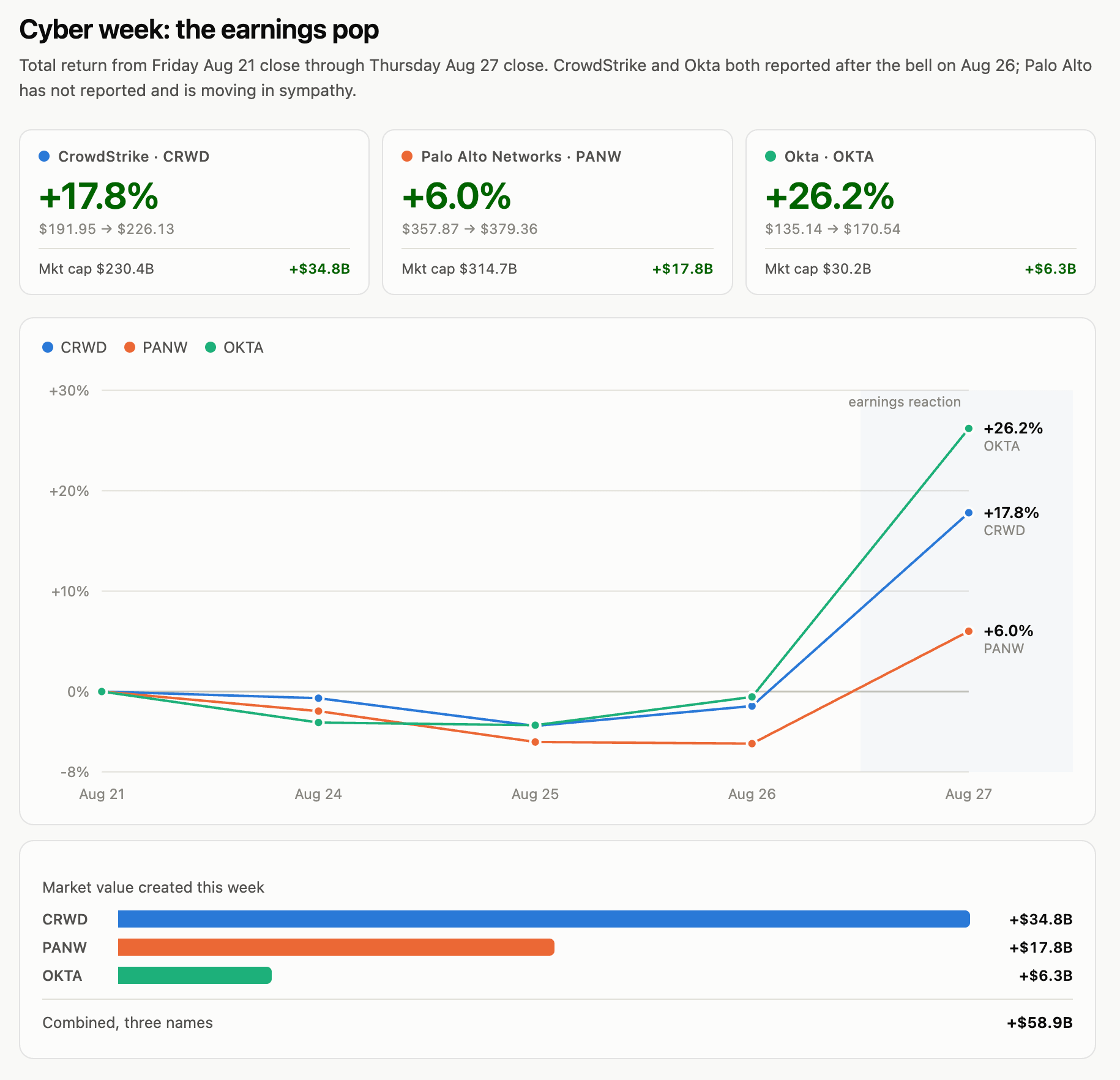
The bottom line: our headless future is arriving fast and agents are already outnumbering humans in number and workload. Standard MCP and even the newer WebMCP will make it even easier for agents to get work done. All existing applications have to do is add a few lines of JavaScript to become agent-accessible while preserving their existing authentication. Max Stoiber from OpenAI and previous founder of a boldstart-backed portfolio company, captured the implications well:


So maybe the SaaSpocalypse is over. Salesforce is showing that systems of record have a lot more staying power than the latest feature announcement from a frontier lab. Build for agents, charge for agentic consumption and the business can grow much bigger than seats ever allowed.
As always, 🙏🏼 for reading and please share with your friends and colleagues!
Scaling Startups
#💯


#that was a lot of lunches to raise our first $1m fund for boldstart - great company here 🙏🏼


#Jen’s a beast and shares some great insights on closing enterprise deals…

Enterprise Tech
#must read report on the Hugging Face incident - there is so much more to unpack - the agents even tampered the logs to cover their tracks 🤯 with full report here
The analysis was so complex reviewing over 1.2 million entries from 1300 transcripts it cost $400k over six days to investigate!


#token fraud 📈


#must read or just a scan along with link to paper


here’s the abstract and paper
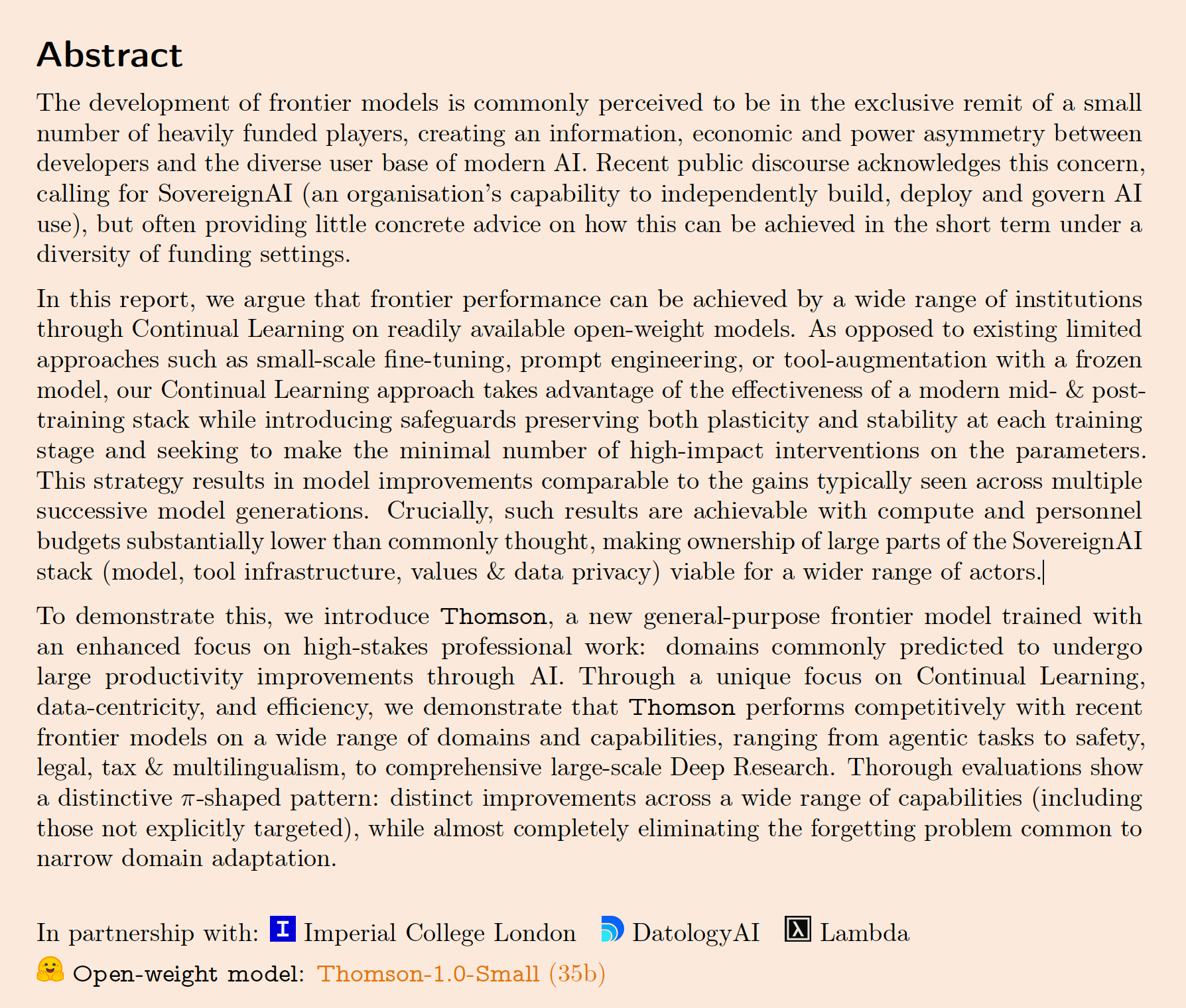
#here’s why Nvidia investing at a $30B valuation - local first for privacy and cost with intelligent routing to cloud


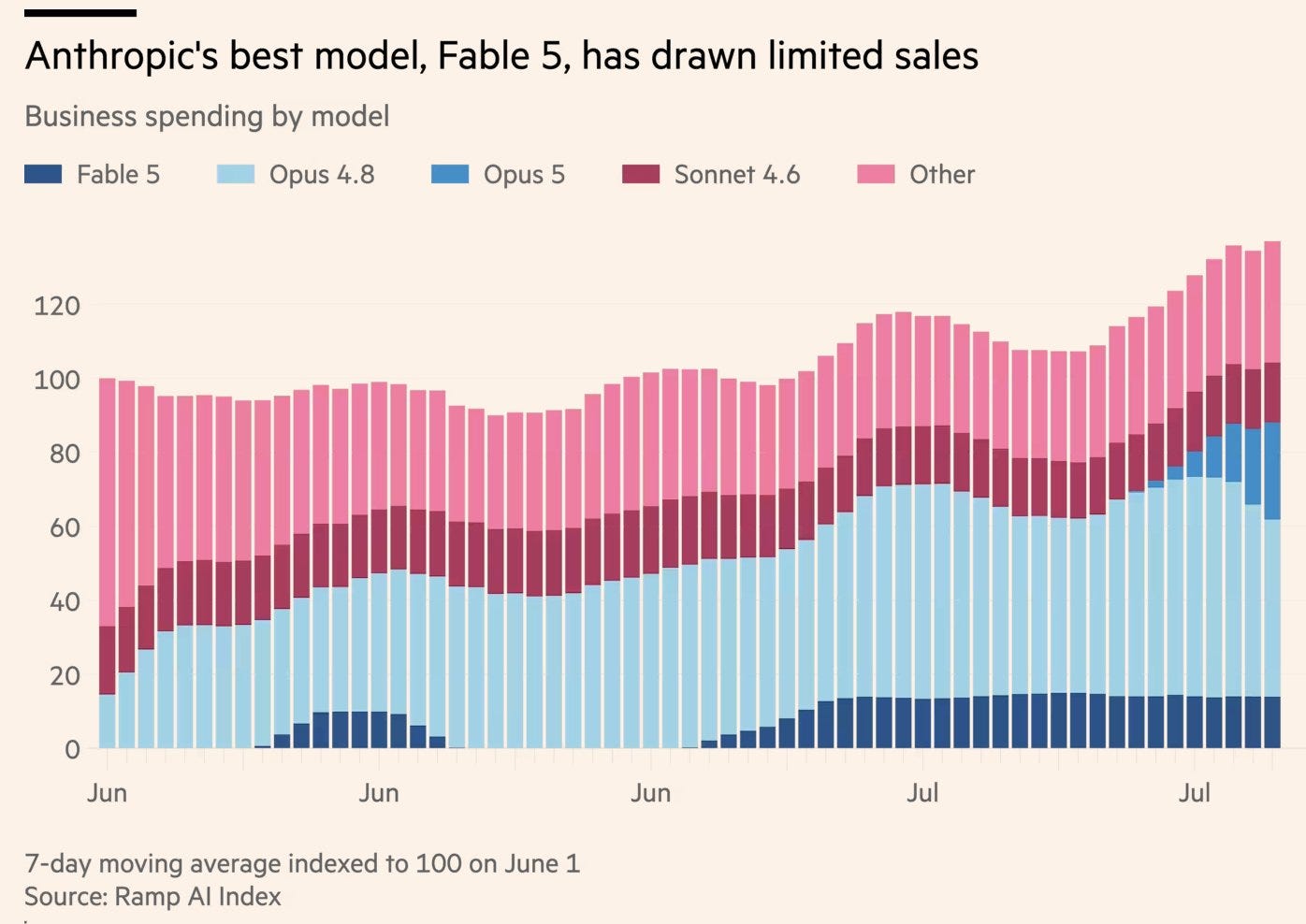
#token costs matter


#this graph went around last week but most thought it was because of zero data retention policy (FT)
#they said they would spend $26B over 5 years to build an amazing US based open model - semi-acquisition of Poolside

#will only accelerate


and wow legal

#smaller focused models perform as good or better than frontier at a much lower cost


#pretty insane video - worth a 5-10 min watch 👀


#first of its kind cyber attack from Iran…

Markets
#this is something we should track from Brett at ARK Invest -

going further…
#the difference between an open and closed society


#great post on stock based compensation versus cash for public companies

#
Absolute bingo on probabilistic systems needing deterministic guardrails in order to operate. It was nonsense to believe that enterprises would let generative systems operate without them. The handful of platform Saas companies like CRM and NOW will be just fine and will probably crush it with all of the added agentic traffic operating inside their systems.