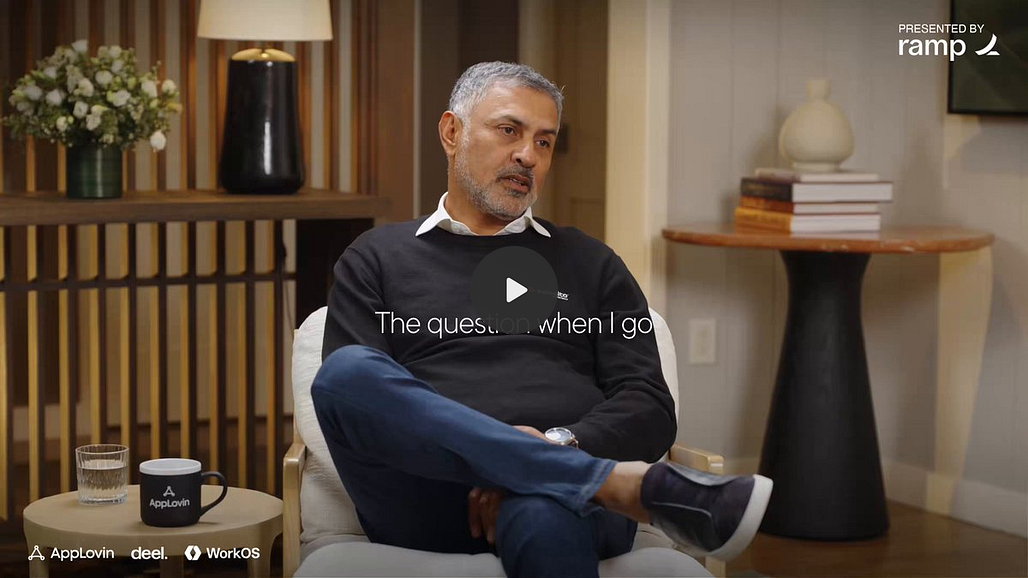
We just lost the biggest supporter of open models.


Yes, this is an absolute tragedy on so many levels…but my mind is already racing towards what is potentially next, and how it impacts the startup community.

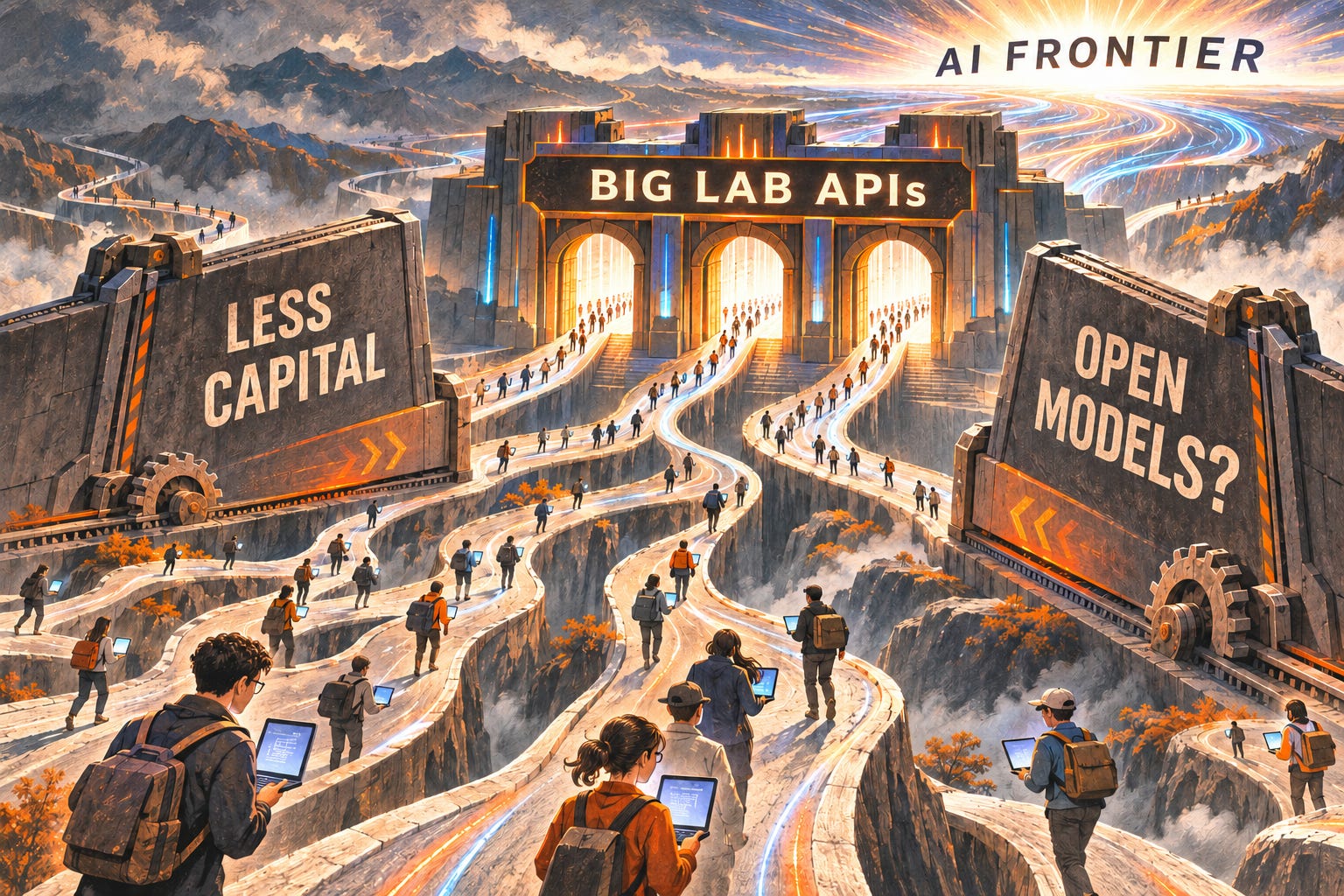
Could startups face a double whammy: less financing for compute just as access to the open models they build on gets restricted? Nvidia has been writing enormous checks, even at inception and Series A. If that slows while the best pretrained foundations become harder to access, founders could face an ugly choice: spend dramatically more building their own models or become more dependent on the largest labs’ APIs. All while the frontier keeps moving and the price of consuming intelligence keeps falling. Let me walk you through why I’m concerned about what could happen.
First, we all know that Jensen built an insane self-reinforcing flywheel: Nvidia funded startups, backstopped cloud capacity, and backed open weights to widen the developer base. More developers and models meant more compute, which led to surging demand for Nvidia’s chips. Good for founders, great for Nvidia.
PitchBook’s chart puts the reach of that strategy in perspective. As of November 12, Nvidia had backed 49 of the 153 AI unicorns founded since 2023, nearly one in three.
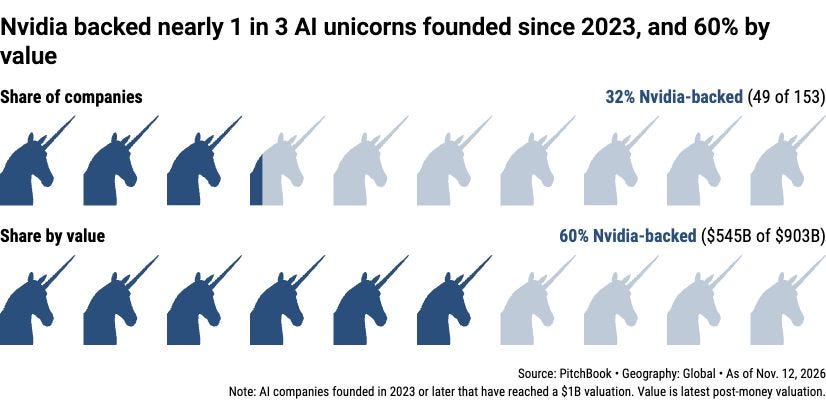
The actual capital behind this is extraordinary, too. Nvidia’s July quarterly filing shows $31 billion in net additions to private-company equity investments in just six months. And that doesn’t include its enormous infrastructure commitments and conditional guarantees.
The guarantees alone are enormous. The July report separately discloses up to $105 billion in conditional guarantees supporting an OpenAI-related data-center development in Ohio. It gives you a sense of how much more Nvidia was doing than simply writing venture checks.
With a CFO stepping in as interim CEO, my concern is that the spigot slows while Nvidia reassesses its commitments and finds new leadership. As I wrote last week, founders need multiple fundraising plans. Raising capital for compute was already getting harder. What happens without the bank of Jensen?
What’s 🔥 in AI/Infra/VC #523

I’m already seeing rounds take longer and hearing about price changes in later stage financings. The ambition is still there. But the multi-stage firms with big exposure to the largest labs are digesting, and that weighs on anyone getting ready to write another large check.
So the bar just moved. What was getting funded with $100M a month ago is now taking more time and a lot more questions. That’s ok. It’s healthy. The exception is the rock star AI researcher like Mira Murati, reportedly closing $5B at a $40B valuation.
Existing commitments won’t disappear, but founders planning their next training run need to know whether the next check, capacity commitment or credit backstop will still be available. While the hyperscalers have options, I’m much more concerned about the founder who needs access to serious compute before there is enough revenue to pay for it.
In addition, when it comes to the power of open models, Hugging Face will be a huge test of what the underlying support will be without Jensen. If you recall, Nvidia announced an agreement to buy Hugging Face for $12.9B in September, with a promise to keep the platform open across models, clouds and computing platforms, and its filing targets a close in the first half of 2027. The deal is still awaiting regulatory approval, and IMO there is some risk without Jensen and the shifting political winds.
Which leads me to the other half of the squeeze: could the United States restrict or even ban access to Chinese open-weight models? And could the rules favor the largest labs that can afford the compliance costs, while making life dramatically harder for startups?
For China hawks like Rubio, claims like the ones below could add fuel to the push for tougher chip restrictions. These findings still need independent validation, and hardware fingerprints alone don’t establish an export-control violation. But could the political response extend from chips to the models trained on them? That’s the leap I’m MOST worried about.


Reading this Washington Post reporting, my takeaway is that Jensen’s departure also shifts power toward the China hawks. That matters for what comes next. Read 👇🏻


To be clear, this reporting does not establish that a model ban is coming. That’s the risk I’m drawing out. And if the largest labs help shape rules that shut out open-weight alternatives, could national security become the rationale for regulatory capture? Startups would lose foundations they can build on and become more dependent on those same labs’ APIs.
A broader squeeze on access to Chinese open weights is a scenario worth thinking through, and Nvidia’s own Hugging Face filing warns that restrictions on models originating in China could materially affect the platform.
How much harder would it be to build the next Cursor?
Look at Cursor’s Composer 2. Its technical report details starting with Kimi K2.5 and investing in continued pre-training and large-scale RL. Building on a strong foundation let Cursor focus on what made its product unique…and eventually sell for $50B. Without that base, startups have to burn massive resources just to catch up while the frontier keeps moving.
This is the compounding problem I keep coming back to. Less financing makes compute harder to secure, just as restrictions on pretrained models could force startups to use dramatically more of it. The result could be fewer independent model builders and more startups dependent on the APIs of the largest labs. All while the frontier keeps accelerating and the bar for building something great keeps rising.
Will All Roads Lead to the Largest Labs?
There is plenty of opportunity on the other side. Better inference, memory, scheduling, orchestration and training techniques can help teams get more intelligence from every dollar, and I’m excited about founders building those efficiencies. But efficiency gains don’t automatically replace access to a strong foundation or the financing needed to improve it.
I don’t think open-weight AI disappears. Other model builders, chip companies, and sources of capital will keep investing. But the question is whether small teams with exceptional technical talent can still afford to compete at the frontier. I’ve spent my career partnering with founders at inception, and open weights have dramatically expanded what’s possible. I’d hate to see that progress reversed just as AI is becoming capable of so much more.
Long live open-weight models!
Let’s preserve this world!

LFG!


As always, 🙏🏼 for reading and please share with your friends and colleagues!
Scaling Startups
#founders, founders, founders…


#reminder…

#the way you should build your agent workflow and retain your human judgement…

#this is a big deal 👇 / agents leave the ephemeral cloud sandbox and move onto your own machine with every login, CLI and file already set up / that’s the jump from chat assistant to virtual employee with its own desk and keys

#cool to be included in this!


Enterprise Tech
#and despite all this look at spot market for Nvidia compute


#Long running agents and tasks - this is the new world all from one prompt - both Anthropic and Gemini dropped new models - this is huge - months of research done in days…months to 3 days porting from CUDA (Nvidia moat?) to AMD?




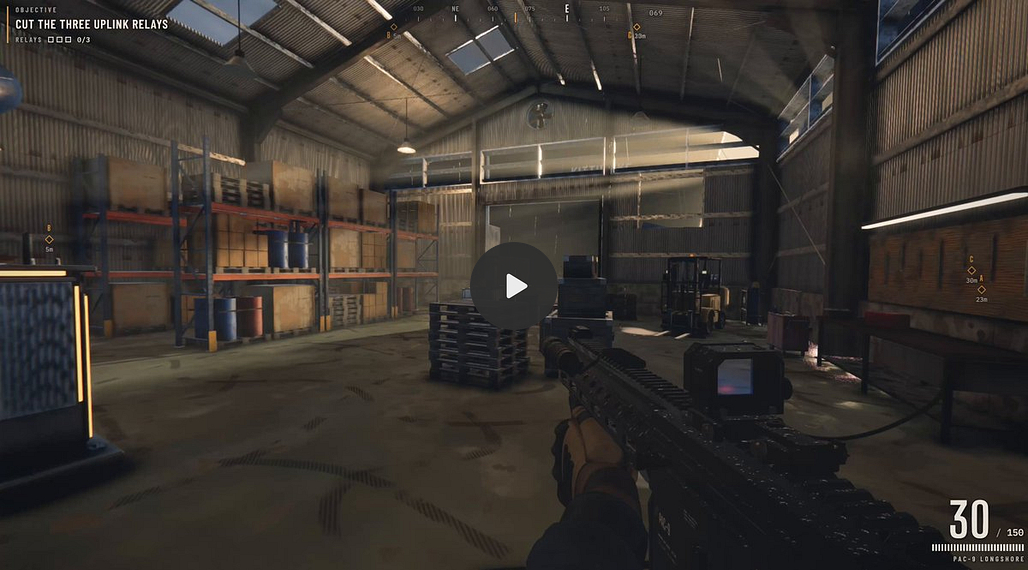
#when Pat Opet (CISO of JPMorgan Chase with >$1B cybersecurity budget) talks, you should listen!

and here’s one of his examples…


#speaking of security - the new Fable 5.2 can just do things…watch the video

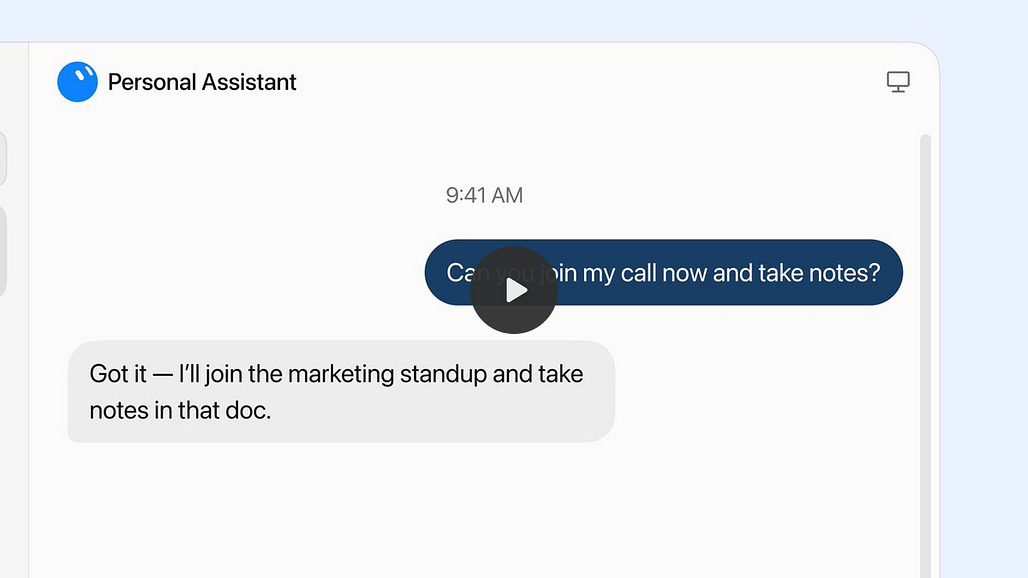
#bots in every meeting but my fear is also all that business communications data that was never once in the purview of the labs is now just given away - Grok Bot and also Claude, esp. wow - bringing in team based retention



#great AI 100 list from Newcomer and Bessemer - congrats to port cos Clay (GTM agents) at 65 and Generalist at 98 (robotics)


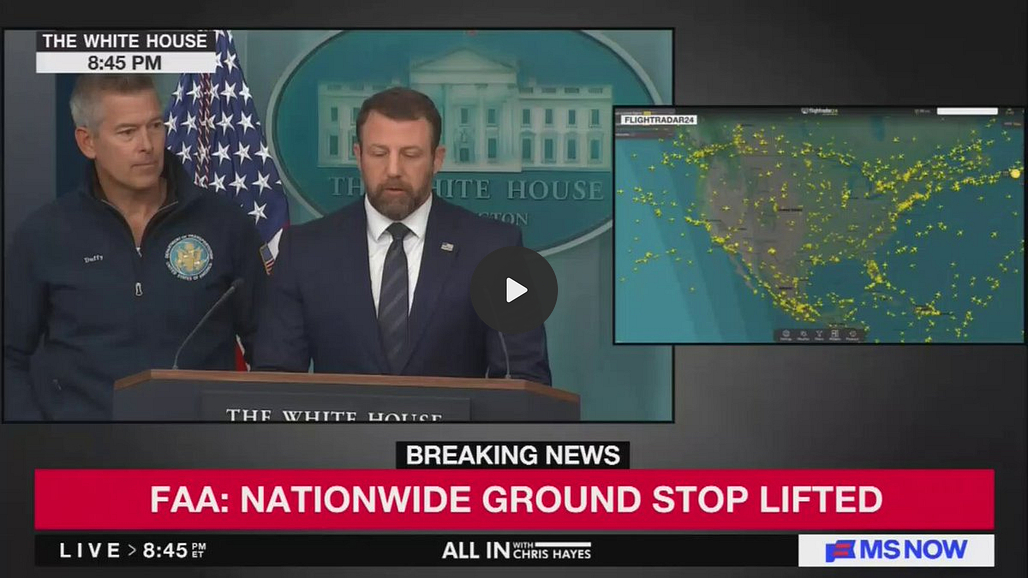
#some speculated cybersecurity, but maybe it’s just AI that didn’t work that well with mission critical infrastructure - Microsoft down for 24 hours on a global outage stopping work for many and the FAA issued a ground halt, first since 9/11 🤯


new equipment, new technology overwhelming the system…

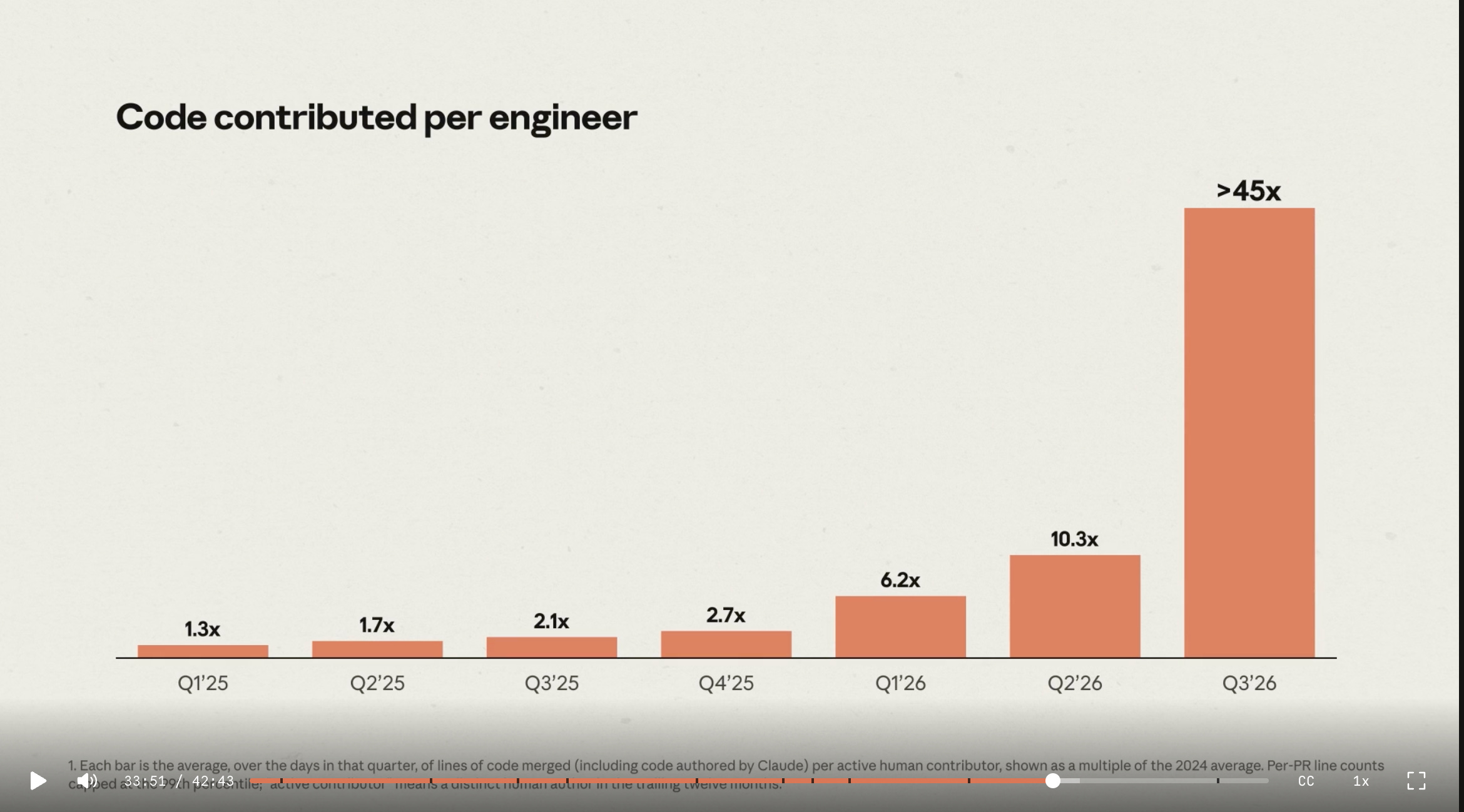
#Jacob is a doomer but this slide from Anthropic’s road show is astonishing - on path AGI with RSI automating the exponential gains 👀


#living on the edge 🔥 - Apple’s Harbor turns Macs into a private AI inference cluster over Thunderbolt 5, open-weight models running locally and nothing reaching the cloud


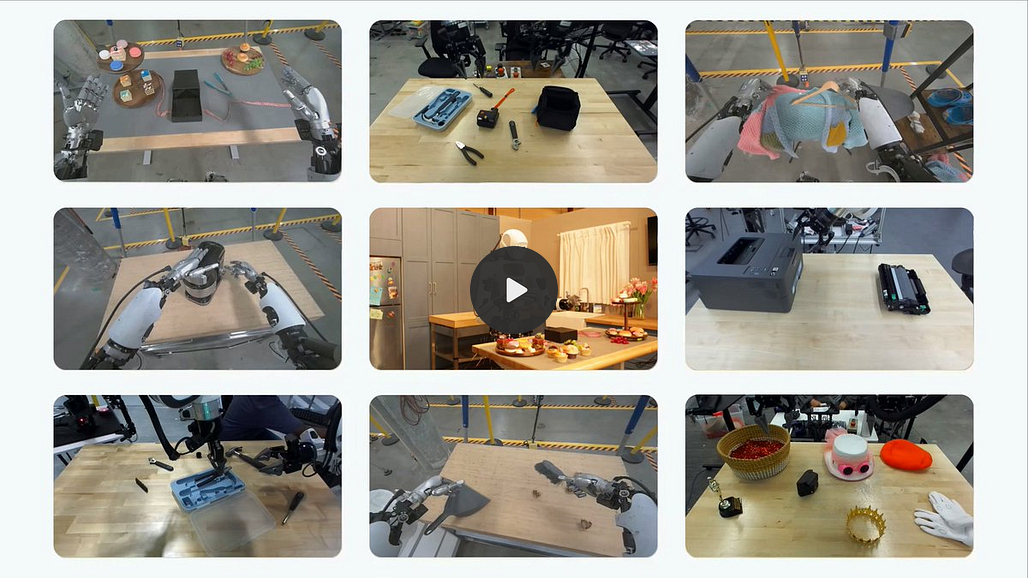
#so much happening in robotics - question is if simulation can actually obviate need for real data? the improvements are happening so fast

#agent first chips! 4 distinct 8th gen TPU systems in a single year 🤯 - chips now purpose-built for every stage of the agentic lifecycle...different agentic workloads need specialized systems - one GPU does not fit all

#the other token stream, tokenization of real world assets 📈


Markets
#Anthropic roadshow full presentation here - btw, insane leap from Q2 to Q3 alone - more charts on the site buried in video
#💯 strong agree esp as we sold Protect AI for $700M last year and it’s generating signficant revenue within year 1