
Here’s a PSA for everyone: more is not better, better is better.

Everyone’s feeling the pressure to do more with less, to justify their existence, to fill the pipeline, but this is the wrong way to view the world. Across the board, I’m seeing incredible amounts of energy expended on activity leading to more work and less results. More POCs does not equal more closed deals. More VC meetings does not mean more money raised. Take a deep breath, pause, and examine your funnel. Where are things breaking down?
I promise you if you qualify better, you will have more time to focus on what truly matters. On the sales pipeline slide, how many board meetings have you been in where the pipeline keeps increasing, and yet you still don’t have predictability on closing and the revenue is still not pouring in. Not all pipelines are created the same, and many times this can give new founders a false sense of security by seeing a a growing pipeline. The reality is that these were never properly qualified in a process, i.e. defining a MQL (marketing qualified lead) to SQL (sales qualified lead) and turned into a real opportunity. These leads can be incredibly expensive to chase down if the upfront work has not been done. Go back to basics and stop reporting vanity metrics. Because of this poor sales pipeline definition and hygiene, founders and execs want to keep spending more money on marketing since the leads are still coming in and carry more sales folks to follow up on all of the leads. This becomes a death spiral - false confidence, more cash burned, and lower conversions. Less is more!
Speaking of doing more with less, meet EdGPT, my new assistant. If you’re a new subscriber or want to know what’s in my head, EdGPT is trained on 6 years of newsletters and in the future I hope to add twitter and other audio clips to better train the model. Go ahead, ask me anything and thanks to friend @NicolaeRusan with HeyPal for getting this up and running.

If you want your own assistant for your substack or website, reach out to Nicolae at HeyPal and point it to your support docs, website, videos, forum, or any text, and get an expert on your topic in seconds.
I caught up with Nicolae (also co-founded Clay.run - a boldstart port co), about what he’s thinking when it comes to generative AI and here’s what he shared.
* Every product will have an assistant inside of it, think a Co-Pilot in every product, and even across them, integrated with your suite of tools. It's a good thing to start exploring, and Pal is a platform for these explorations.
* Similar to how Wordpress made it easy to get a site up and running, Pal is making it easy to get your assistant up and running, integrating data from the tools you use, striking a balance that makes it easy to get going without code, but providing APIs and extensibility for developer teams.
* Content-aware LLMs (assistants) have a variety of use cases - from co-pilot & customer support for your end users, to internal knowledge searching (private assistants that support your core team), to personal recall and knowledge support (like EdGPT) :) . There's startups appearing in each of these categories.
* Assistants are inherently multi-channel, the natural language interface makes them usable on the site, Slack, Discord, and more.
I agree with much of what Nicolae has to say and feel like this is a new era for SaaS applications. Frankly the last 5 years have become quite stale with little innovation on the application layer, and it will be an interesting battleground to see if existing SaaS apps with AI added to a massive installed base will continue to dominate, or if there is room for AI-first applications built from the ground up with these LLM models weaved into every aspect of the application. For me, I’m still trying to figure out the dev tooling angle to see if there is a turnkey layer to sit between the LLMs to enable mass adoption in apps - similar to how liveblocks (a boldstart portfolio co) enables real time collaboration in apps (see below).

BTW, this is not the first time chat bots dominated the scene as I’ve seen this movie before so many times 😃 (see what’s 🔥 #319 on my investment 20 years ago in Smarter Child).
As always, 🙏🏼 for reading and please share with your friends and colleagues. Also please don’t forget to have fun with EdGPT which is trained on 6 years of weekly newsletters and more data will be fed over time.
Scaling Startups
Overhead - if you don’t know who to call to get work done, fix the problem The Pragmatic Engineer
 Gergely Orosz@GergelyOroszWith news of Meta aiming to flatten their management chain, I talked with engineers and managers at the company on their thoughts. An engineer shared how it feels reporting chains in some orgs are out of hand. The ones below are actual chains for some outlier IC positions:
 8:00 PM · Feb 9, 2023195 Reposts · 2.38K Likes
founder mentality in 2023 🪖
Ed Sim@edsimthis is what I call optimism + what it takes in 2023, from 1 of our founders "I might be wrong -- obv i am wired for standing in the middle of a burning 🔥 building + only seeing an oppty to sell smores -- but this could be a massive oppty for us for some ST gains pick up."1:38 PM · Feb 10, 20232 Reposts · 8 Likes
Enterprise Tech
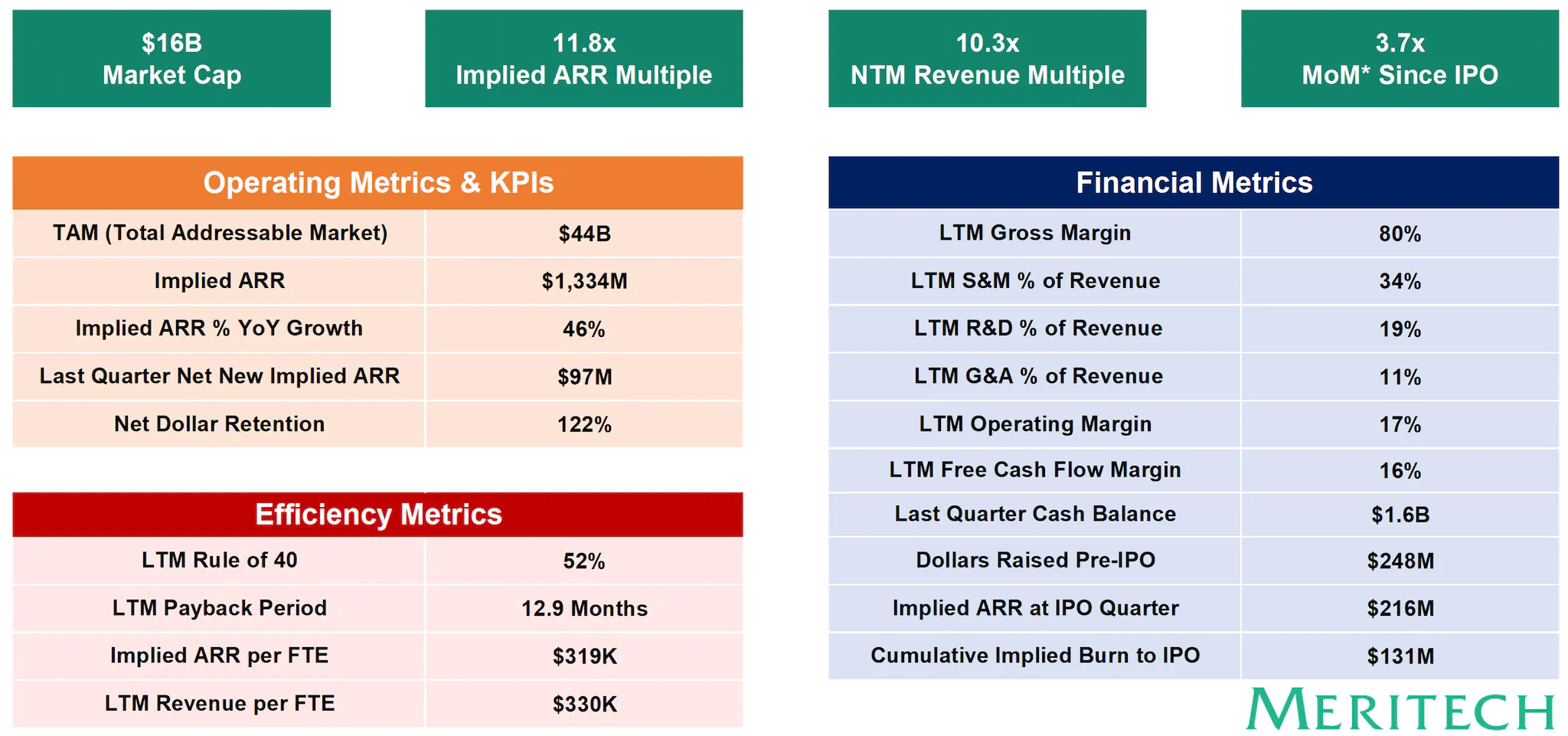
Now that forward revenue multiples are down from 100x, let’s look at what an amazing 10x enterprise company looks like - this is from Meritech - see full report - lots of infra cos here - notice Rule of 40 at 52% median along with Net $ Retention of 122%
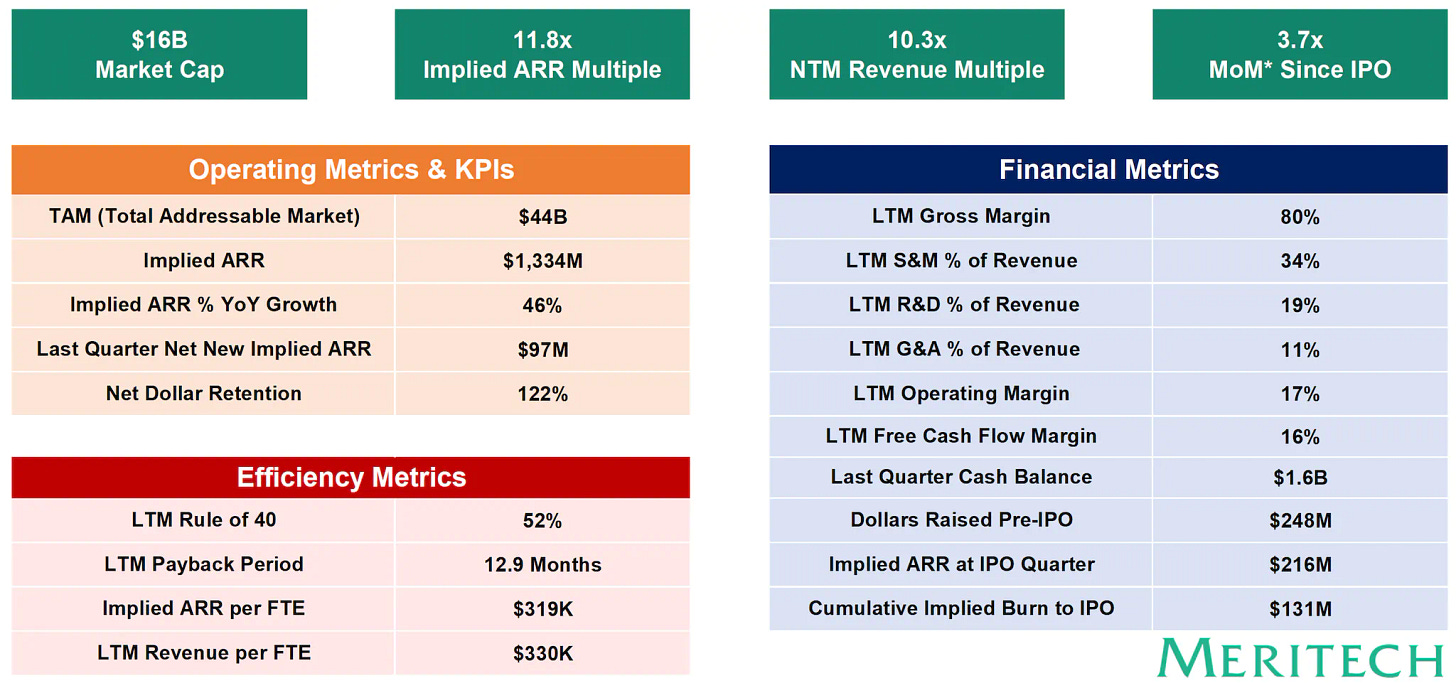
Developer first startups not immune as both Gitlab (7% or 130 employees) and Github (10% or 300 employees) announce layoffs this week
From Sid, Gitlab CEO
“The current macroeconomic environment is tough, and as a result, companies are still spending but they are taking a more conservative approach to software investments and are taking more time to make purchasing decisions,” Sijbrandij said in his message to employees.
“I had hoped reprioritizing our spending would be enough to withstand the growing global economic downturn. Unfortunately, we need to take further steps and match our pace of spending with our commitment to responsible growth,” the CEO told employees.
NewRelic now enters DevSecOps space…🤔 - can’t let Datadog be only observability co going after it
Chris Aniszczyk (@cra@macaw.social)@cra🤔 going over the latest $NEWR earnings report and this pattern of every traditional monitoring company becoming a security company continues (vice versa will be true too in due time)... "Expanding into DevSecOps" newrelic.com/newrelic.com/p… 3:04 PM · Feb 8, 20231 Repost · 1 Like
Is era of Big Data over? Must read from Jordan Tigani - founder of MotherDuck, serverless data analytics + founding engineer Google BigQuery
The most surprising thing that I learned was that most of the people using “Big Query” don’t really have Big Data. Even the ones who do tend to use workloads that only use a small fraction of their dataset sizes. When BigQuery came out, it was like science fiction for many people-- you literally couldn’t process data that fast in any other way. However, what was science fiction is now commonplace, and more traditional ways of processing your data have caught up.
This post will make the case that the era of Big Data is over. It had a good run, but now we can stop worrying about data size and focus on how we’re going to use it to make better decisions. I’ll show a number of graphs; these are all hand-drawn based on memory. If I did have access to the exact numbers, I wouldn’t be able to share them. But the important part is the shape, rather than the exact values.
SEC deals a death blow to crypto staking? Yes and No…
Gary Gensler@GaryGenslerToday @SECGov charged Kraken for the unregistered offer & sale of securities thru its staking-as-a-service program. Whether it’s through staking-as-a-service, lending, or other means, crypto intermediaries must provide the proper disclosures & safeguards required by our laws.8:16 PM · Feb 9, 20231.52K Reposts · 4.42K LikesRead Konstantin Richter response from Blockdaemon which offers a staking as a service platform to many of the largest institutions - it’s a matter of nuance
Blockdaemon 😈@BlockdaemonHQ#Blockdaemon maintains its mission to connect institutions to blockchains with easy integrations and safely on-ramp millions of users without ever taking control of any user assets. Read more about our Founder & CEO’s @konstantin11 thoughts on the blockdaemon.com/blog/a-message…… https://t.co/UUQJzA8xzV 9:20 PM · Feb 10, 20234 Reposts · 6 Likes
Microsoft - the browser end around - who needs ChatGPT 3.5 built in the app like Notion if it’s in the browser? (The Verge)
“Chat” allow users to summarize the webpage or document they’re looking at and ask questions about its contents, while “compose” acts as a writing assistant; helping to generate text, from emails to social media posts, based on a few starting prompts.
Another day, another rebrand of old school SaaS 🦄 into ChatGPT powered sexy co - “TripActions Rebrands as Navan, Adds ChatGPT to Expense Reports” - With the reset, the business-travel software startup is taking on market leader Concur with new tools, CEO says - from WSJ
WASMup - WebAssembly to Let Developers Combine Languages - The New Stack - still need to ensure security - lots of smart folks building here…
“The way the world works today, because you exist in the JavaScript ecosystem and I exist in the Rust ecosystem, we can’t intersect, and that means that entire swaths of developers, your frontend people and your backend people treat each other almost adversarially,” Hayes said. “That’s part of what the component model is meant to enable, is that I can seamlessly work across language boundaries in a portable way.”
With the component model, developers could build a library in C++, a library in Rust, and a library in Python — or any other language, including JavaScript — and be able to build them together like Lego bricks, to make a complete application, she explained. And since security is the first concern for WebAssembly, they’d be able to do it in a secure way.
“The easiest analogy that people will understand is that it’s like going from a static library, static executable, to being able to work with dynamic libraries — but in terms of WebAssembly modules and with strict types and being able to expose those types to other WebAssembly modules that are components,” Hayes said. “It means that we completely change the way that we write software today. It means all of these silos that have existed for 20 years are gone.”
Another outstanding episode. Thank you, Ed 👌.
The Pragmatic Engineers calls out the convoluted hierarchy in Big Tech very well. Middle managers are really a perfect target for layoffs. Bloomberg did a recent piece on this too. Increasing span of control is a easy to execute move and has little to no impact on work output in the short term. However, long term there are risks like limited career opportunities or lack of innovation that's driven by managers.